Every carat. Every hand‑off. One ledger.
CaratOS tracks your rough from purchase through sawing, cutting and polishing to sale, with weight, cost and worker at every step. No more workbooks. No more guessing.
See it
Three things a workbook cannot tell you.
Not a mock. Every figure below is a capture of the product holding real weight and real money.
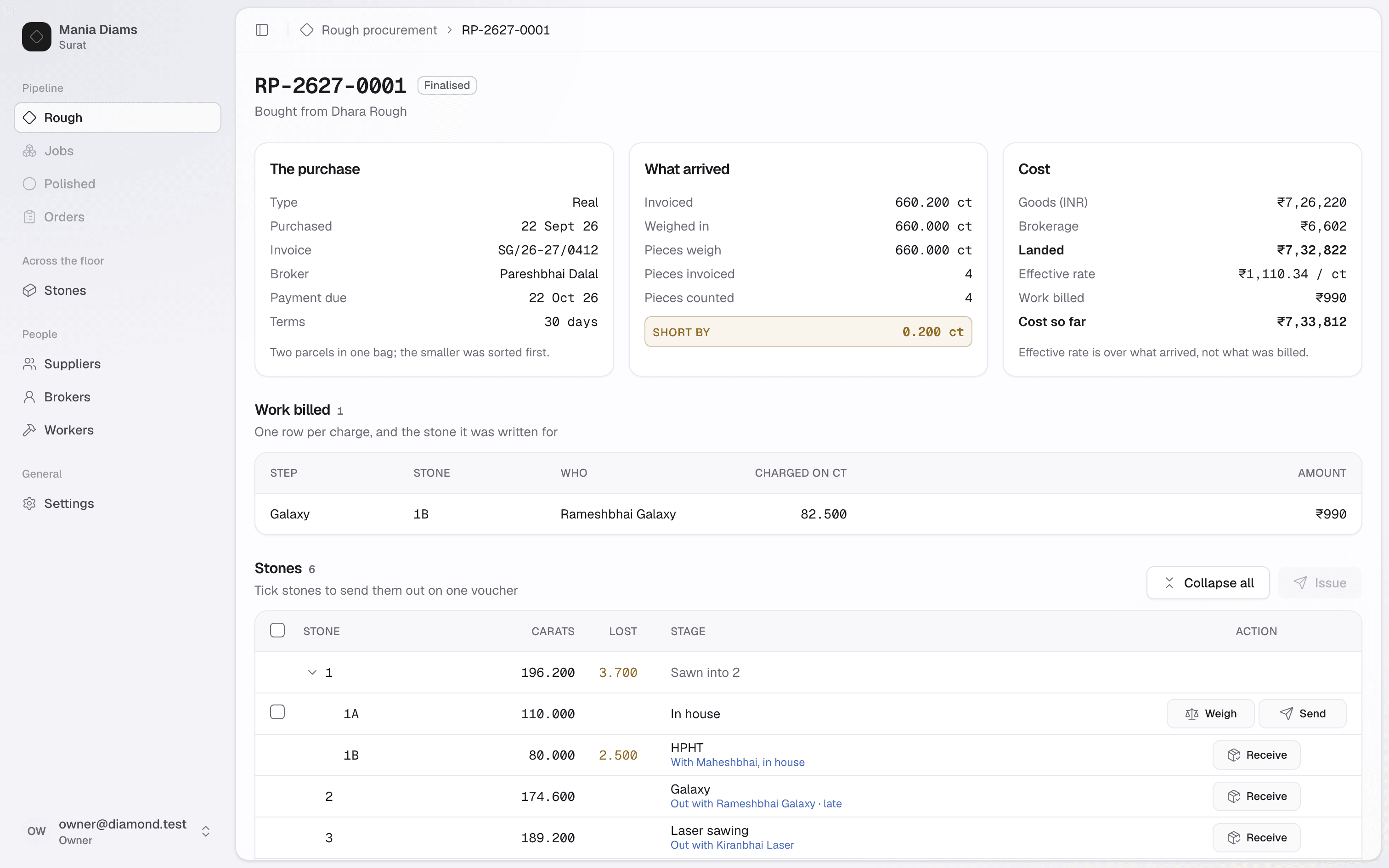
What arrived
Two weights, both kept
What the supplier invoiced and what your scale said are never the same number. Both stay on the record, and the rate is worked on what arrived.
- A packet of 30 back as 27 is an ordinary row
- Goods, duty, freight and brokerage stay separate
- Terms and due date sit on the purchase
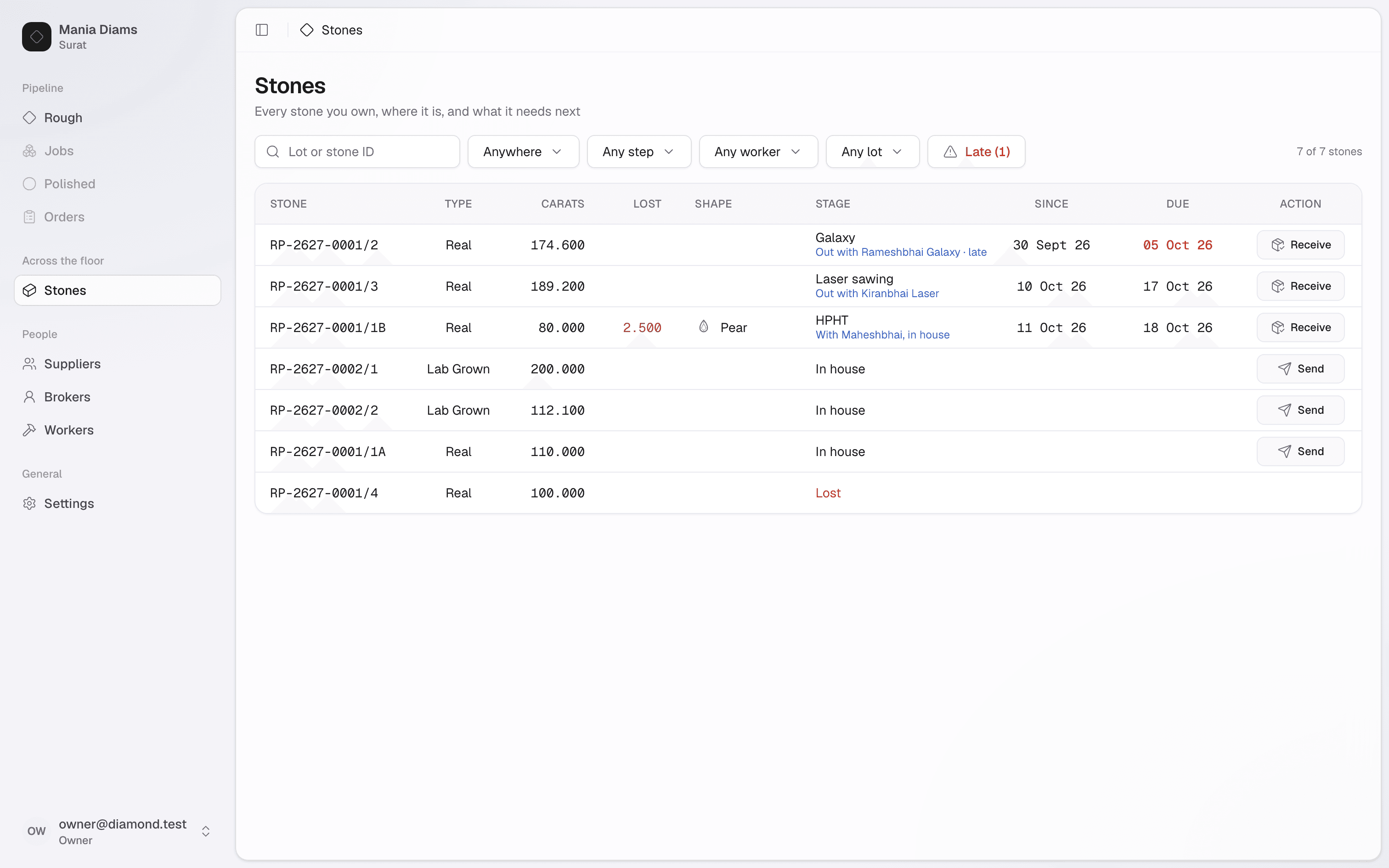
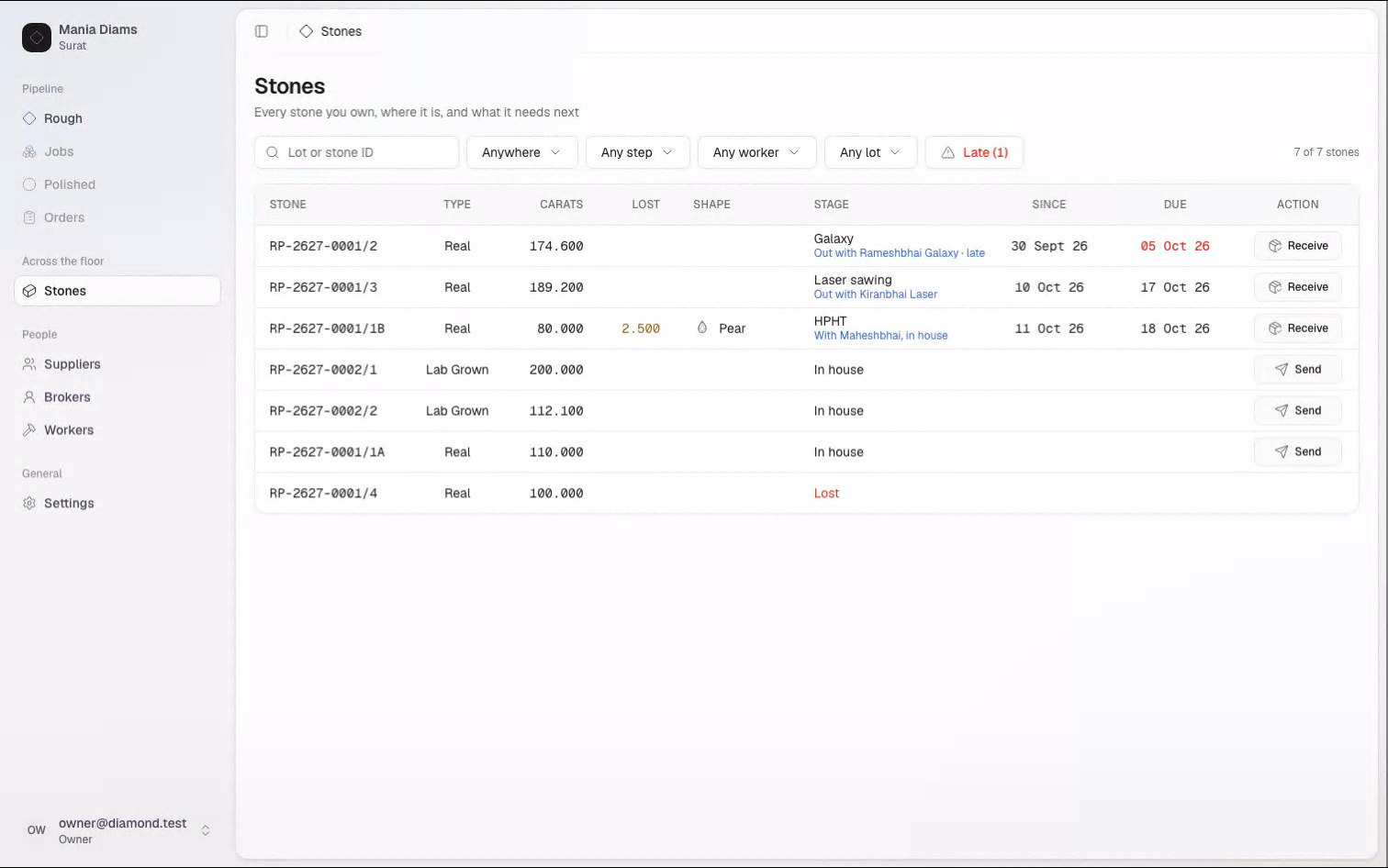
Where it is
Every stone, and who holds it
A stone goes out for a step and comes back weeks later. Issue and receipt are one entry, so the register always says who has it, since when, and how late.
- Goods out are still yours
- An overdue return is red before anyone asks
- Memo goods stay on your ledger, costed
What it cost
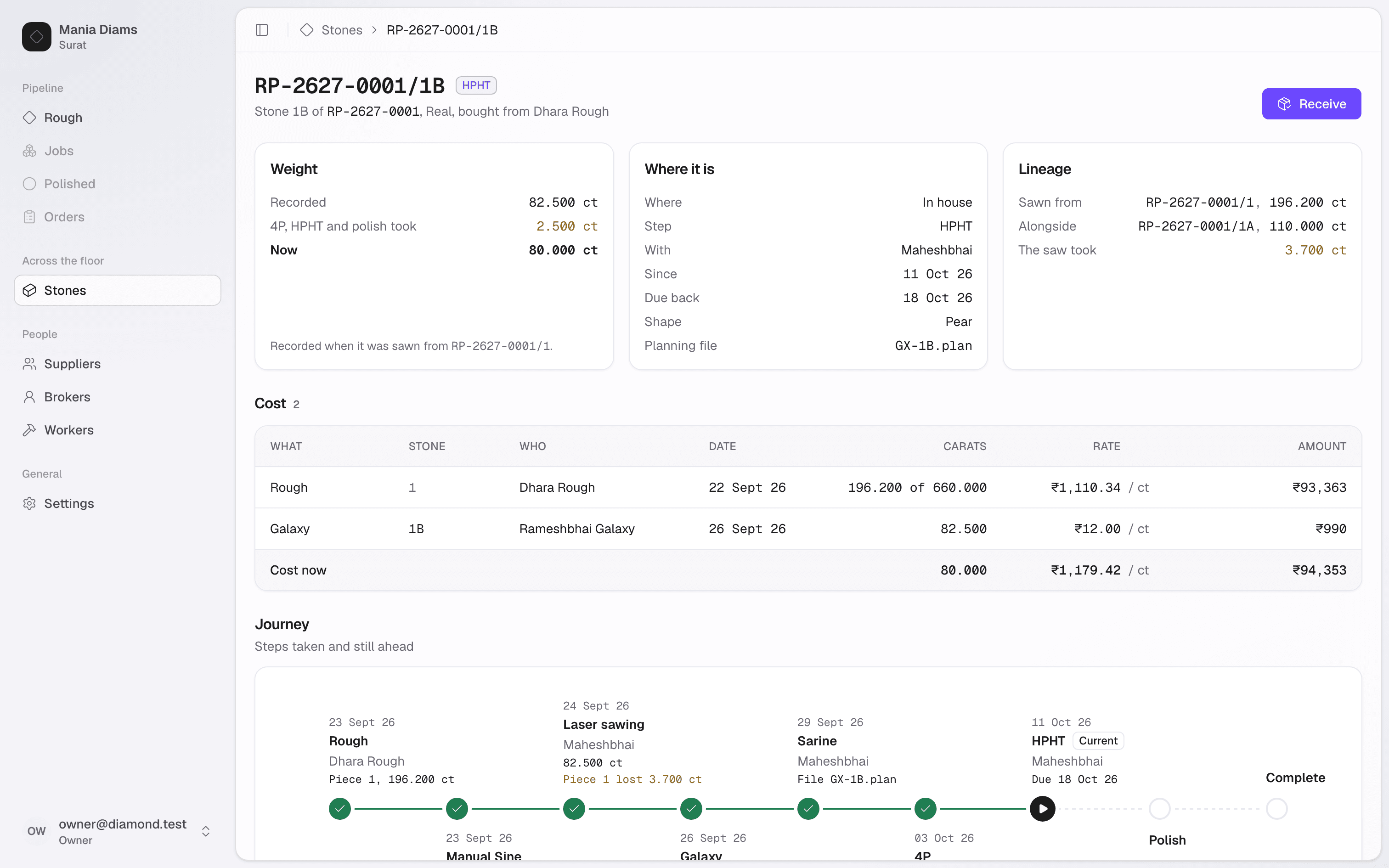
Cost follows the stone
A lot’s landed cost reaches every stone it holds, and each step adds its charge to the stone it was done on. What a stone has cost is a list of rows.
- The rough arrives with its cost
- A saw splits the parent across its children by weight
- Each step bills at the rate current that day
- 0.001 ct
- the resolution of every weight on record
- 2
- weights on every parcel, invoiced and weighed
- 0
- rows ever overwritten; a correction is a new row
The problem
The diamond trade runs on weight and cost. Most of it lives in separate workbooks.
01
Nobody knows where a stone is
A lot goes out to a worker, the trade's karigar, for sawing. Six weeks later nobody can say which worker has it, what it weighed when it left, or whether it came back.
02
Weight moves. Cost does not follow.
A rough is sawn into three. The landed cost stays on the parent row in a workbook, and the margin on each polished stone is a guess.
03
Jangad disappears into notebooks
Goods on memo are still your stock, but they live in a separate register with no weight, no cost and no name against them.
How it works
From rough to polished, one continuous record.
- 1
Rough in
Invoiced weight and weighed-in weight, both recorded, both kept. A parcel short or heavy is a row with a number on it.
- 2
Plan and saw
Galaxy scans the stone; laser sawing splits it. The loss belongs to the piece that was cut, never spread across its children.
- 3
Out to a worker
Sine, 4P, HPHT, polish. Each step names who, when out, when due. Goods out are still yours, and late is red.
- 4
Back in house
Return weight recorded, loss written down, cost carried onto what survived.
- 5
Sold or on memo
Sold at carats times rate, less discount, per line. On memo, it is still your stock, still costed, still yours.
Who it is for
Built for the people running the actual business.
Real and lab grown
Manufacturer
You buy rough and sell polished.
- Every parcel from rough purchase to polished sale
- What is sitting with each worker, and for how long
- The margin on each stone after every process cost
- Weight lost at every step, written down
Polished, memo, stock
Merchant
You buy, hold and sell polished.
- Stock position across in-house and memo goods
- Goods out on memo are yours until they return or sell
- Shape and size inventory with landed cost on every lot
- Margin on every sale without opening a spreadsheet
Visibility and control
Owner
You want to know what you own.
- Total position at any moment: weight, cost, location
- Nothing disappears into a notebook on a desk
- Staff see what they need. Rates stay private.
- One system instead of four workbooks
Why we built it
A weight that moves without its cost moving with it is how a diamond business loses money invisibly.
We built CaratOS because we ran into this ourselves, in Surat. The workbooks got too big. The workers had more parcels than the register could track. A stone would come back lighter and the loss would quietly disappear into the average.
Staff see weights, never money
Rates, landed cost and margin are unreachable to a staff login. Not hidden on the screen, unreachable.
Nothing is overwritten
A row carrying weight or money is never edited. A correction is a new row, and both survive the argument months later.
Every row has an owner
Each weight and each rupee belongs to one organisation, and reaching it is by membership. Nothing sits above that.
Know what you own. At any moment.
Bring a purchase, a worker register and a sales sheet. We walk the same stones through CaratOS with you, on a call, in under an hour.